

 1. Basic Definitions and Technological Evolution
1.1 Core Concepts
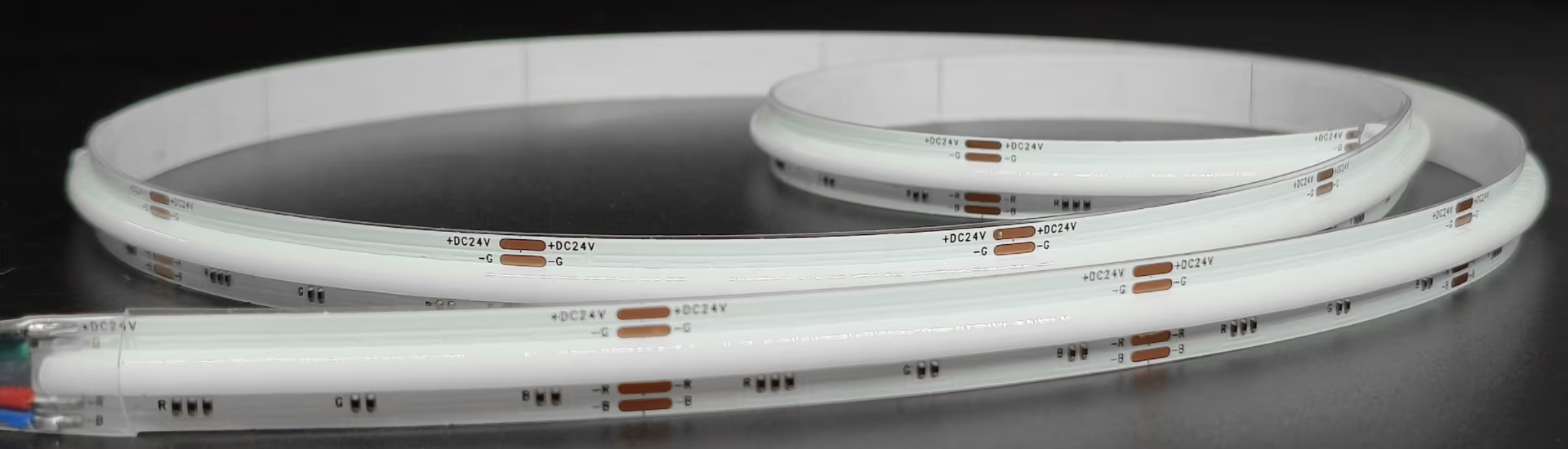
RGB LED Strips (Three-Primary-Color Mixing System):
- Utilizes red (R), green (G), and blue (B) LED chips.
- Color mixing achieved via PWM (Pulse Width Modulation).
- Typical control precision: 8-bit per channel (256-level dimming).
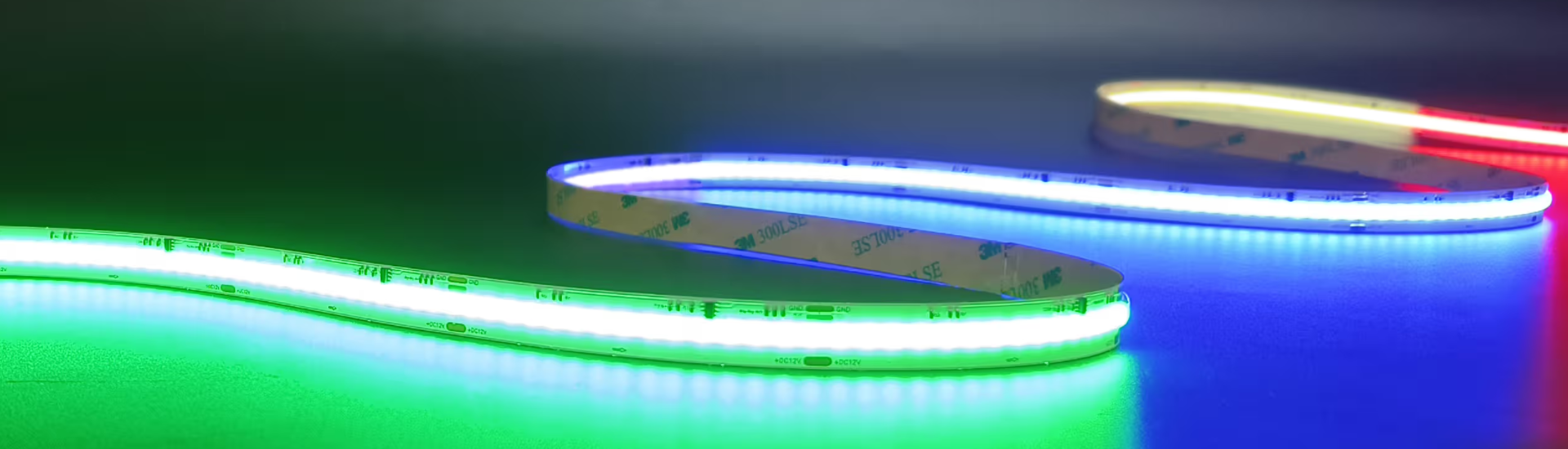
Programmable LED Strips (Addressable Digital Strips):
- Integrated with smart ICs (e.g., WS2812B/SK6812).
- Supports individual LED addressing via serial communication protocols (SPI, UART).
- Typical refresh rate: 800Hz–2000Hz.
1.2 Technological Milestones
- 2003:First commercial RGB strips with parallel circuit design.
- 2010:WS2811 IC enabled single-wire cascading control.
- 2015:SK9822 IC introduced PWM+SPIX dual-mode driving.
- 2022:Third-gen programmable ICs achieved 48-bit color depth (16-bit/channel).
- 2024:AI-driven ICs enabled dynamic lighting effects (e.g., Tuya Smart iT5 solution).
2. Hardware Architecture Comparison
2.1 Physical Structure Differences
| Feature | RGB Strips | Programmable Strips |
| LED Packaging | 3-in-1 SMD | 4-in-1 COB (with integrated IC) |
| Circuit Topology | Parallel segment control | Serial cascading architecture |
| Cable Specs | 3-wire (R/G/B) | 4-wire (VCC/DIN/GND/CLK) |
| Pixel Density | 30–60 LEDs/m | 60–144 LEDs/m |
2.2 Key Components
Programmable Strips:
- Driver IC:Built-in latch and PWM generator (e.g., TM1914 with 24MHz clock).
- Signal Amplifier:Repeater chips every 5m (enhances signal integrity).
- Waterproofing:IP68-rated silicone sleeve + potting process (withstands 50kPa pressure).
Performance Limits:
- Max Cascading Length:RGB ≤10m; Programmable up to 100m (with signal boost).
- Response Latency:RGB 50–100ms; Programmable <5ms (@144Hz refresh).
3. Control Systems & Protocol Architecture
3.1 Communication Protocols
RGB Strips:
- Analog voltage dimming (0–10V).
- DMX512 standard (512 channels).
- DALI-2 digital interface (bidirectional).
Programmable Strips:
- Single-wire NZR coding (WS281x series).
- Dual-wire differential transmission (APA102 protocol).
- Wireless Mesh (Bluetooth 5.2 multi-node sync).
3.2 Control Solutions
- Smart Home:Xiaomi Zigbee 3.0 (syncs 1000+ nodes); Huawei HarmonyOS AI color mapping.
- Professional:Madrix software for 3D particle effects.
4. Optical Performance Testing
4.1 Lab Data
| Parameter | RGB Strips | Programmable Strips |
| Color Gamut | 85% sRGB | 120% NTSC |
| Gradient Smoothness | Visible stepping (ΔE >5) | ΔE <1.5 |
| Dynamic Response | 30fps | 240fps |
| Lumen Maintenance | 5000h @70% brightness | 20,000h @180B10 |
4.2 Special Scenario Performance
- High-Speed Photography:No flicker under 1/1000s shutter.
- Color Accuracy:AE2000=0.8 on Munsell chart.
- Extreme Conditions:Cold start <100ms at -40°C.
5. Application Scenario Guide
5.1 Cost-Benefit Analysis
| Factor | RGB Strips | Programmable Strips |
| Install Cost | ¥15–30/m | ¥50–200/m |
| Power Use | 7.2W/m | 14.4W/m (full brightness) |
| Maintenance | 2-year cycle | 5-year warranty |
| ROI Period | 8 months (commercial) | 14 months (exhibitions) |
5.2 Application Matrix
Choose RGB Strips for:
- Warehouse lighting.
- Low-cost window displays.
- Temporary event setups.
Require Programmable Strips for:
- Immersive art exhibitions (e.g., TeamLab).
- Automotive dynamic lighting.
- Virtual film production.
- E-sports arena ambiance.
- Smart city traffic visualization.
6. Future Technology Outlook
6.1 Material Innovations
- Flexible Micro LED:Samsung’s 0.5mm bendable strips.
- Self-Powered:MIT’s light-harvesting strips (23% efficiency).
- Thermochromic Coatings:Linde Group’s sub-1s response material.
6.2 Smart Interaction
- EEG Control:NeuroLight brainwave-based systems.
- Haptic Integration:Apple’s capacitive sensing fabric.
- LiDAR Mapping:3D environment-aware lighting.
Conclusion
The choice between RGB and programmable LED strips hinges on balancing basic functionality with creative potential. While RGB serves fundamental needs, programmable strips redefine spatial experiences. As the metaverse and IoT converge, next-gen smart lighting will transcend physical boundaries, bridging virtual and real worlds. Consumers must weigh scenario complexity, budget flexibility, and scalability to craft optimal lighting strategies.